
Water Resources
Water Resources – Chapter 3 Class 10 Geography (NCERT)
Water Resources is Chapter 3 of Class 10 Geography (Contemporary India – II). It covers the importance of water as a renewable resource, causes of water scarcity, and methods of conservation and management. The chapter includes multi-purpose river valley projects, rainwater harvesting techniques, advantages and disadvantages of dams, and government water conservation programmes. It builds awareness on sustainable water use. Below are complete notes aligned with NCERT, RBSE and CBSE board exam patterns.
Water a Renewable Resources
About 75% of the earth’s surface has water. Only a small part is freshwater that humans can use. Freshwater comes from surface runoff (rivers, lakes) and groundwater. It is renewed by hydrological cycle. This cycle moves water through evaporation, condensation, precipitation, and infiltration. It recycles water and makes it a renewable resource. Still, water scarcity is a big problem. By 2025, about 2 billion people may face absolute water scarcity.
Water Scarcity and The Need For Water Conservation and Management
Common Misconceptions About Water Scarcity
Many people believe that water scarcity only occurs in regions with low rainfall or drought-prone areas, such as the deserts of Rajasthan.
However, water scarcity is not always caused by low rainfall. It often results from over-exploitation of water resources, excessive water use, and unequal access to freshwater.
What is Water Scarcity?
Water scarcity is the lack of sufficient freshwater resources to meet the needs of people in a region. It may occur due to natural shortages or due to improper use, infrastructure, and management.
Major Cause Water Scarcity
Water scarcity happens when the available freshwater is not enough to meet the needs of people, farming, and industries. It can be caused by natural reasons or human activities. The main causes are:
1. Over-Exploitation of Water
Excessive withdrawal of water for irrigation, industrial production, and household use leads to rapid groundwater depletion and reduced surface water levels. In many places, too many tube wells and bore wells are used, which leads to shortage.
2. Unequal Access to Water Resources
Water is not always shared equally. Poor people and villages often get less clean water, while cities and rich areas get more. This makes the problem worse in drought-prone areas.
3. Pollution of Water Sources
Water bodies such as rivers, lakes, and groundwater are polluted by domestic sewage, industrial waste, pesticides, and chemical fertilizers. This contamination makes water unsafe for drinking, irrigation, and other essential uses.
4. Growing Population
When the population increases, more water is needed for drinking, cooking, washing, and growing food. This puts extra pressure on the water supply.
5. Rapid Urbanization and Industrialization
Bigger cities and more factories need a lot of water for production, construction, and daily use. This increases the demand and causes shortage.
Jal Jeevan Mission (JJM)
- Launched: August 2019 by the Government of India
- Aim: Provide safe drinking water via Functional Household Tap Connections (FHTC) to every rural household
- Service Level: 55 litres per person per day
- Focus: Long-term, regular, and sustainable water supply
Need of Water Conservation
Saving Water resources is necessary to make sure there is enough clean water for everyone now and even the future. The main reason are:
- Prevent health problems by ensuring clean and safe water for all.
- Ensure enough water for farming to maintain food supply.
- Support livelihoods and industries that depend on water.
- Protect rivers, lakes, forests, and other natural ecosystems.
- Avoid water shortage and environmental problems in the future by preventing overuse and mismanagement.
Atal Bhujal Yojana (Atal Jal)
- Launched: 25 December 2019 as a Central Sector Scheme
- Aim: Encourage communities to shift from overuse to conservation and smart water management
- Coverage: 7 States – Gujarat, Haryana, Karnataka, Madhya Pradesh, Maharashtra, Rajasthan, and Uttar Pradesh
- Beneficiaries: 8,220 water-stressed Gram Panchayats in 229 blocks across 80 districts
- Reason for Selection: These states contain ~37% of India’s water-stressed areas (over-exploited, critical, and semi-critical blocks)
Multi-Purpose River Projects and Integrated Water Resources Management
Ancient Hydraulic Structure
- Ancient India developed advanced water harvesting and irrigation systems such as dams, lakes, and canals.
- 1st century B.C.: Sringaverapura (near Prayagraj/Allahabad) had a sophisticated rainwater harvesting system to channel floodwater from the Ganga.
- Mauryan period (Chandragupta Maurya): Large-scale construction of dams, reservoirs, and irrigation canals for agriculture.
- Regional irrigation works: Found in Kalinga (Odisha), Nagarjuna Konda (Andhra Pradesh), Bennur (Karnataka), and Kolhapur (Maharashtra).
- 11th century: Construction of Bhopal Lake, one of the largest artificial lakes of its time.
- 14th century: Hauz Khas tank in Delhi, built by Iltutmish, supplied water to Siri Fort.
Dams
A dam is a solid barrier built across a river, stream, or other flowing water to block, store, or control the flow of water. It creates a reservoir or lake behind it, which can be used for irrigation, drinking water supply, flood control, hydroelectric power generation, and recreation. Examples:
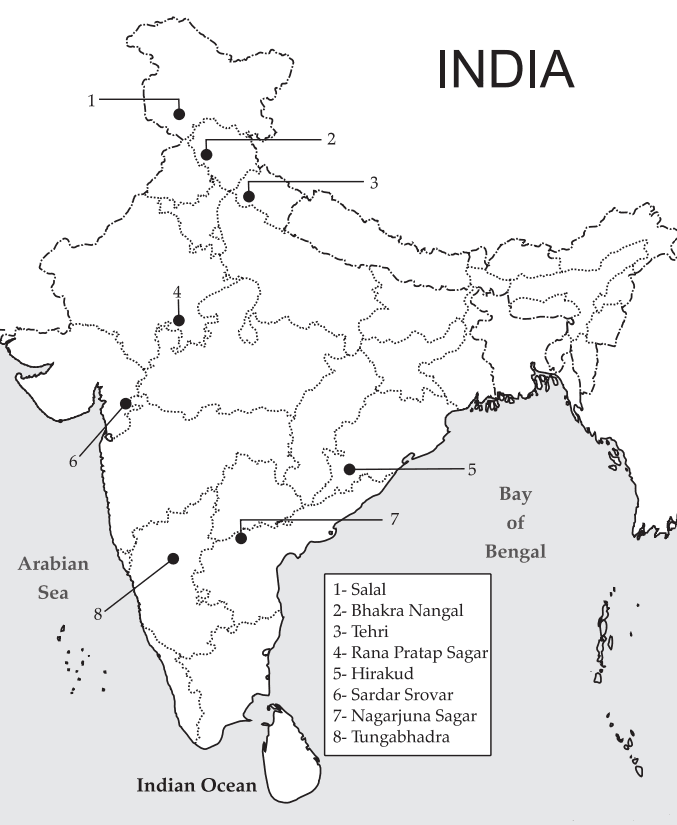
- Gandhi Sagar on Chambal (Madhya Pradesh)
- Hirakud on Mahanadi (Odisha)
- Nagarjuna Sagar on Krishna (Telangana and Andhra Pradesh)
- Tehri on Ganga (Uttarakhand)
- Mettur on Kaveri (Tamil Nadu)
- Salal on Chenab (Jammu and Kashmir)
- Bhakra Nangal on Sutlej (Himachal Pradesh and Punjab)
- Sardar Sarovar on Narmada (Gujrat)
- Rana Pratap Sagar on Chambal (Rajasthan)
- Tungabhadra on Tungabhadra (Karnataka and Andhra Pradesh)
Spillway or Weir: A structure on a dam that safely releases excess water downstream, preventing overflow and protecting the dam.
Sardar Sarovar Dam
- Built on the Narmada River in Gujarat.
- One of the largest water resource projects of India covering Maharashtra, Madhya Pradesh, Gujarat, Rajasthan.
- Aim: Provide water to drought-prone and desert areas.
- Irrigation coverage:
- Gujarat: 18.45 lakh hectares, 3112 villages in 15 districts.
- Rajasthan: 2,46,000 hectares in Barmer & Jalore.
- Maharashtra: 37,500 hectares in tribal hilly regions via lift irrigation.
- 75% of Gujarat’s command area and entire Rajasthan command area are drought-prone.
- Assured water supply will make these regions drought-proof.
Uses of Dams (Multi-Purpose Projects)
- Irrigation – Supply water to agricultural fields for crop growth.
- Hydroelectricity generation – Produce electricity for domestic and industrial use.
- Flood control – Regulate river flow to prevent flooding.
- Recreation – Promote tourism, boating, and other leisure activities.
- Inland navigation – Enable water transport through reservoirs and canals.
- Fish breeding – Support aquaculture and fisheries in dam reservoirs.
- Drinking water supply – Provide safe water for households and industries.
Examples: Hirakud Dam (Mahanadi River): Water conservation + Flood control.
Bhakra Nangal Dam (Sutlej-Beas basin): Irrigation + Power production.
Pradhan Mantri Krishi Sinchayee Yojana
The PMKSY was started to make sure every farm in the country gets some form of irrigation. This will protect crop, improve harvests and help farmer liver better lives. Key objectives:- Water for every farm and increase the area under irrigation (Har Khet Ko Pani).
- Improve on farm water use efficiency and reduce wastage. (Per Drop More Crop)
- Promote sustainable water conservation.
Problems or Disadvantages of Dams
1. Environmental Impact
- Changes the natural flow of rivers.
- Reduces sediment flow, leading to excessive sedimentation in reservoirs.
- Creates rockier stream beds and destroys aquatic habitats.
- Blocks migration and spawning of aquatic species.
- Flooding from reservoirs submerges vegetation, leading to its decay and the release of harmful gases.
2. Flood Problems
- Sedimentation reduces water storage capacity, increasing flood risks.
- Ineffective in controlling floods during extreme rainfall events.
- Floodwaters released from dams lack silt (a natural fertilizer), leading to land degradation.
- Floods can cause loss of life, property, and severe soil erosion.
3. Soil and Agriculture and Agriculture Problems
- Irrigation from dams has changed cropping patterns, with farmers shifting to water-intensive commercial crops
- These crops require excessive watering, which increases the risk of soil salinization
Other Problems
- Can induce seismic activity in certain regions.
- Promotes the spread of waterborne diseases and pests.
- Leads to pollution from excessive water use.
Krishna Godavari Dispute
- States involved: Maharashtra, Karnataka, Andhra Pradesh.
- Cause: Maharashtra’s plan to divert more water at Koyna for a multipurpose project.
- Objection: Karnataka and Andhra Pradesh say this will reduce downstream water flow.
- Impact: Could harm agriculture and industry in Karnataka and Andhra Pradesh.
Question: Who described dams as the ‘Temples of Modern India’? and Why?
Answer: Jawaharlal Nehru described dams as ‘Temples of Modern India’. Because Nehru believed that dams would boost agriculture and village economy with rapid industrialization and growth of the urban economy.
Rainwater Harvesting
The process of collecting and storing rainwater for later use, providing a sustainable alternative to large dams and supporting both people and the environment.
Traditional Rainwater Harvesting Systems in India
In ancient India, people had a strong tradition of water conservation. They understood rainfall patterns and soil types and developed various methods to collect rainwater, groundwater, river water, and floodwater, using techniques suited to local conditions and their water needs. Some of main methods are:
- Guls/Kuls: Diversion water channels in hilly area for agriculture. (Himalayas)
- Khadin and Johads: Rain water storage in agricultural fields. (Rajasthan). Khadin in Jaisalmer and Johads in other parts of rajasthan.
- Inundation Channels: Irrigation canal from flood water. (Bengal)
- Tankas: Underground tanks built in houses for storing drinking water collected from rooftop rainwater harvesting. (Rajasthan)
Roof Top Water Harvesting
Definition
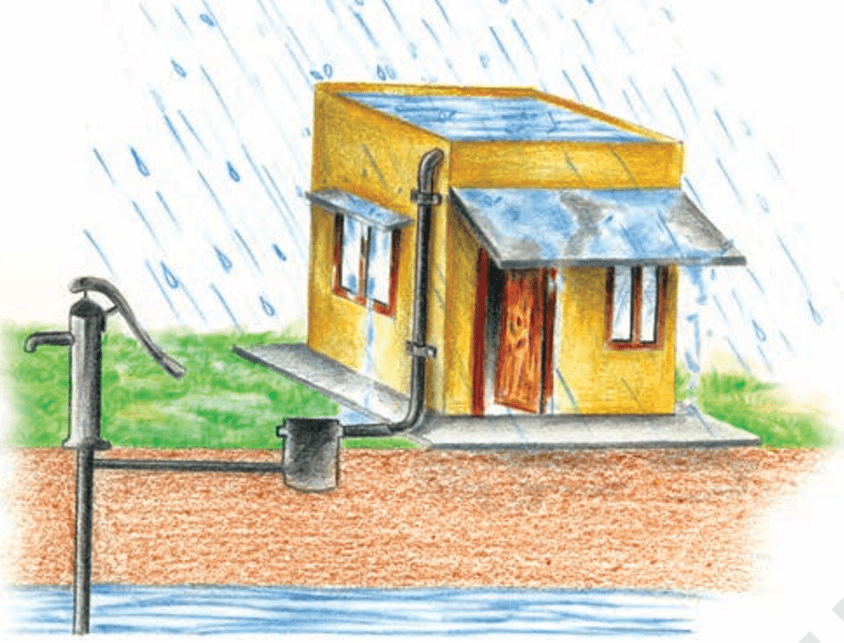
The process of collecting and storing rainwater from the roofs of buildings, which can then be used for drinking, irrigation, or other domestic purposes.
Procedure
- Rain falls on sloping roofs.
- Water flows through pipes into a storage tank (usually underground Tankas).
- The first rainfall is not collected, as it is used to clean the roof and pipes. Subsequent rainfall is stored.
- The stored water can be used directly for domestic purposes or to recharge groundwater.
Advantage
- Provides a reliable source of drinking water; rainwater, or “palar pani,” is considered the purest form of natural water.
- Some houses had underground rooms next to Tankas, using the stored water to keep the room cool in summer.
- Helps in recharging groundwater.
Examples of Roof Top Water Harvesting in India
- Rajasthan: Traditional tanks in Phalodi, Barmer, and other areas.
- Shillong, Meghalaya: Despite heavy rainfall, water shortages exist; 15–25% of the total water requirement comes from rooftop rainwater harvesting.
- Gendathur, Karnataka: A village near Mysuru where 200 homes use rooftop harvesting, collecting around 1 lakh liters per year.
- Tamil Nadu: The first state in India to make rooftop rainwater harvesting compulsory by law.
Question. Which place receives the highest rainfall in the world?
Answer. Mawsynram and Cherrapunji in Meghalaya, India.
Bamboo Drip Irrigation
Bamboo drip irrigation is a 200-year-old traditional method used in Meghalaya. In this system, water from hilltop springs is carried to farms through bamboo pipes, using gravity to ensure a natural flow. The bamboo pipes are designed to gradually decrease in size, slowing the water flow so that it reaches the plants drop by drop—about 20–80 drops per minute—ensuring efficient irrigation and minimal water wastage.
Water Resources – Practice Questions
Explore Our Quality Contents
All Class 10 Social Science Chapters
All Class 10 Science Chapters
Suggest Links
NCERT Official Text Books
Rajasthan Board Official Site
CBSE Official Site