
The Rise of Nationalism in Europe
The Rise of Nationalism in Europe – Chapter 1 Class 10 History (NCERT)
The Rise of Nationalism in Europe (Class 10 History) continue the story of how nationalism began in Europe with the French Revolution and later shaped the unification of countries like Germany and Italy. Nationalism, which began as a movement for freedom and unity, later became aggressive in Europe. To show their strength, these nations expanded their control over Asia, Africa, and especially the Balkans. This growing tension in Europe and the Balkan region finally became a major cause of World War I. Below are complete notes of this chapter aligned with NCERT, RBSE, and CBSE board exam patterns.
Frederic Sorrieu’s Dream (1848)
In 1848, a French artist named Frederic Sorrieu made four prints. In these, he showed his dream of a world full of Democratic and social republics (Countries where people are free and equal). This first print is The Dream of Worldwide Democratic and Social Republics – The Pact Between Nations.
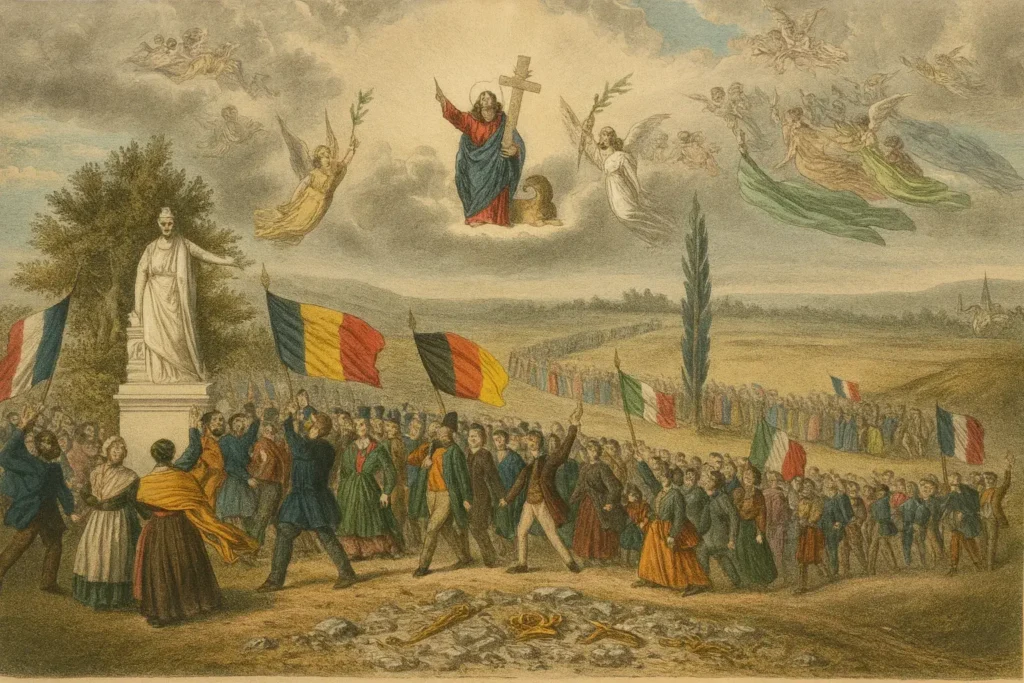
- People from Europe and America are marching together. Men and women of all ages and classes walk in a long line. They are going to the Statue of Liberty to show respect.
- Liberty is shown as a lady holding a torch of Enlightenment in one hand and the Charter of Rights of Man in the other. This means freedom and equal rights for all people.
- On the ground, we can see broken crown, swords, and symbols of kings and empires. This shows the end of absolute monarchy and the victory of democracy.
- People are shown of different nations, wearing their national dresses and carrying their flags.
- At the front, we see the United States and Switzerland – they were already free countries. Then comes France with its tricolor flag, followed by Germany, Austria, Italy, Poland, England, Ireland, Hungary, and Russia.
- Above them, in the sky, angels, saints, and Christ are watching. They show peace, love, and brotherhood among nations.
Meaning of The Picture: The pact of nation is one of the four prints prepared by Frederic Sorrieu (1848). All nations are marching together towards liberty and old symbols of kings and empires are broken on the ground. Everyone is united, happy, and treated equally. It shows Utopian Vision – Perfect dream world that people wished for but did not exist in real life at that time.
The French Revolution and The Idea of The Nation
The first clear feeling of nationalism started with the French Revolution (1789). Before the revolution, France was ruled by an absolute king who had all the power. After the revolution, power passed to the people. It was declared that the nation belongs to its citizens, not to the king. French revolutionaries started many steps and actions that could make people feel united and part of one group. Such measures are:
- The Ideas of La patrie means the fatherland and Le citoyen means the citizen.
- New tricolour flag (blue, white and red) replaced the old royal flag.
- The Estates General (Old parliament) was now elected by citizens and renamed the National Assembly.
- Made Uniform laws and centralized administration.
- Abolished internal customs duties.
- French became the common language.
The French Revolution inspired people in Europe to form Jacobin clubs and spread the ideas of freedom and nationalism.
Napoleon’s Reforms
After the French Revolution, the king was removed, and France became a republic. But later a strong army leader named Napoleon Bonaparte became very powerful. People supported him and he made himself king of France. Napoleon introduced many reforms:
- Introduced Napoleonic Code or Civil Code of 1804. Main points are:
- Ended all privileges by birth.
- Give right to property.
- Made everyone equal before the law.
- Simplify administrative divisions.
- Ended Feudal System (Make farmers free form landlords and serfdom).
- To make trade simple and easy, he introduced uniform weights and measures and a common currency.
- He introduced these laws in many countries under French control like Italy, Holland, Germany, and Switzerland.
At first, people in area under French control welcomed French as bringers of freedom. But soon they became unhappy because there was no real political freedom, Heavy taxes, Strict censorship, and Forced army services made life difficult. So, their early joy turned into anger and resistance against French rule.
The Making of Nationalism in Europe
In the 18th century, countries like Germany, Italy, and Switzerland were not as single nations. They were divided into many small kingdoms and states ruled by different kings. People spoke different languages and followed different cultures. So, they didn’t feel like one nation – only loyal to their ruler.
The Aristocracy and The New Middle Class
In Europe, the Landed Aristocracy (Rich landowners) was the most powerful class. They had large estates, town houses, and Spoke French in high society. Their families were rich and connected through marriage, and few in number. Most of the remaining people were peasants (farmers). Farmers are either own small land (in west) and worked as serfs on large land (in east).
Later, with the growth of industries and trade, new groups appeared like businessmen, industrialists, professionals, and workers. This was the rise of the new middle class. These educated and liberal. They wanted freedom, equality, and unity and end the special rights of the aristocracy. They spread nationalism.
What did Liberal Nationalism Stand for?
“Liberalism” (liberal = free) means Freedom. For the middle class, liberalism meant:
- Freedom for each person and equality before the law.
- Government chosen by people, not kings.
- End of monarchy and Church control.
- Right to private property.
When national unity was linked with liberalism collectively known as Liberal Nationalism. The spirit of nationalism with the values of liberty and equality introduced by French Revolution.
- Political Meaning
- Liberals wanted freedom and equality before law.
- They opposed King’s absolute power.
- They wanted a constitution and elected government.
- But only rich men could vote and no rights for women and poor.
- Economic Meaning
- They supported free trade and no taxes between states.
- Wanted one currency and same weights and measures.
- Believed trade should be easy and open for all.
- Example: Zollverein (1834) is an economic union formed by Prussia, joined by most German States.
- Social Meaning
- Opposed birth-based privileges.
- Everyone should be equal in society and law.
- Wanted a society based on merit and talent, not status.
The Zollverein (1834)
The Zollverein was a union of German states to make trade easy and free. It was started in 1834 under the leadership of Prussia (German state). The main objectives are:
- No tax barriers inside the German states.
- The number of currencies was reduced from more than 30 to just 2.
- Create one common economic area for trade.
- Develop Railways so people and goods could move easily.
- Increase one nation feeling between Germans.
A New Conservatism After 1815
Napoleon was defeated in 1815. European rulers wanted to bring back the old order that existed before the French revolution and Napoleon. This period saw the rise of a new conservatism – a belief in tradition, monarchy, and stability.
Conservatism: A political belief that supports keeping old monarchy traditions, customs, and institutions. Conservatives wanted gradual change, not revolution. They accepted some modern ideas to make monarchy stronger like modern army, good administration, no feudalism, and strong economy.
Congress of Vienna (1815)
- After Napoleon’s defeat, rulers of Britain, Russia, Prussia, and Austria met at Vienna. The meeting was called the Congress of Vienna. It was hosted by Austrian chancellor Duke Metternich.
- Main goal: Balance of power in Europe and no more revolution. Undo Napoleon’s changes and restore old monarchies.
- New boundaries made to stope France from expanding again:
- France: Bourbon kings were restored.
- Netherlands: Formed by joining Belgium and Holland to check France.
- Austria: Got control over northern Italy.
- Prussia: Got parts of Saxony and Rhine region.
- Russia: Got part of Poland.
Conservative Regimes
- Governments were Autocratic (One ruler has full power).
- No freedom of speech or criticism.
- Censorship was imposed on newspaper, books, plays, and songs.
- Liberal and nationalist ideas were banned.
Caricature “The Club of Thinkers” (1820)
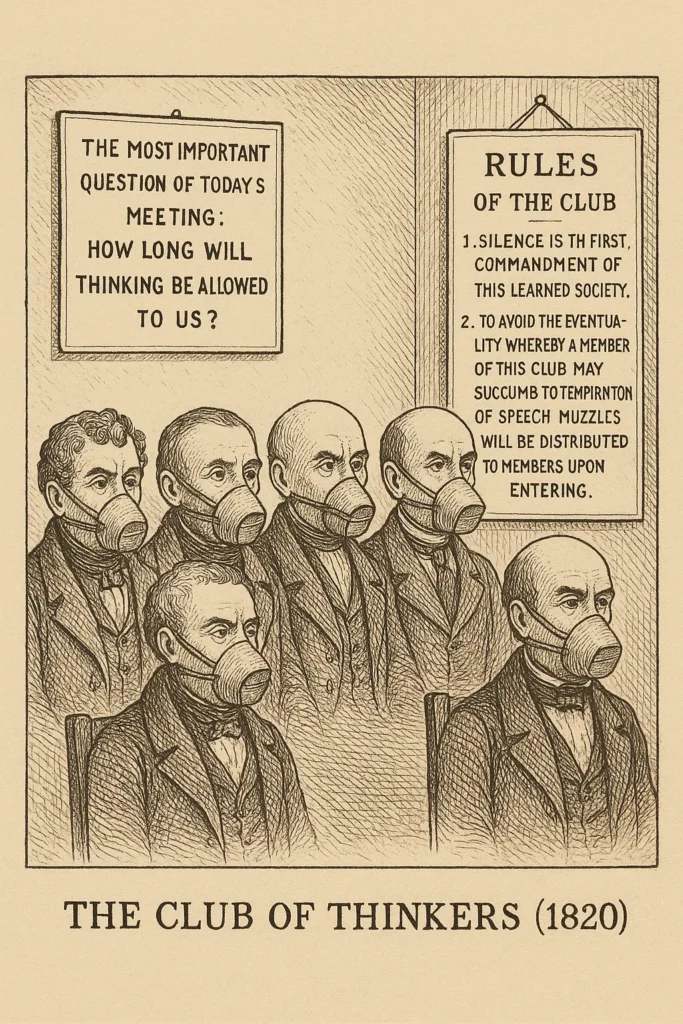
- Shows thoughts of people controlled by rulers.
- Board says: Silence is the first rule.
- Members are not allowed to speak or think freely.
- Represents the lack of freedom under conservative rule.
The Revolutionaries
- People who opposed kings and fought for liberty and national unity were known as revolutionaries.
- Secret societies: Many secret groups were formed in different parts of Europe. Their aim was to train revolutionaries and spread ideas of liberty and nationalism.
- Main Goal: To build independent nation states with freedom and equality.
Giuseppe Mazzini (1805-1872)
- Born: Genoa, Italy (1805).
- Member of a secret group called Carbonari.
- Tried to start a revolution in Liguria, but failed and was exiled.
- Founded two more underground societies:
- Young Italy (in Marseilles)
- Young Europe (in Berne).
- Members of these groups were young men from Italy, France, Germany, and Poland.
- Mazzini believed “God wanted nations to be natural units of mankind”.
- He wanted to make Italy a single unified republic.
- Dreamed of world made of free, equal, and democratic nation.
- His ideas inspired secret societies across Europe.
- Metternich (Austrian ruler) called him “The most dangerous enemy of our social order”.
The Age of Revolutions: 1830-1848
Between 1830-1848, several revolutions took place demanding freedom and national unity. These revolution lead by liberal nationalists belonging to the educated middle class.
- Revolution in France – July 1830: The Bourbon king was overthrown by liberal revolutionaries. They set up a constitutional monarchy under Louis Phillippe. This event inspired revolts across Europe. The Austrian minister Metternich Said: “When France sneezes, the rest of Europe catches cold.”
- Belgium’s Independence: The French Revolution inspired Belgium to revolt and become independent from the Netherlands.
- Greek War of Independence (1821-1832): Greece fought against the Ottoman Empire. They started a war of Independence in 1821. Treaty of Constantinople (1832) – Greece became independent.
The Romantic Imagination and National Feeling
- Romanticism was a cultural movement that helped develop nationalist feelings through art, poetry, music, literature, emotion, history, and folk culture.
- Examples: Johann Herder: True spirit of the nation (Volksgeist) lived among the common people (das Volk) and their folk songs, stories, and traditions. Grimm Brothers collected German folktales to promote unity.
- Poland is divided between Russia, Prussia, and Austria. Music and language kept the national spirit alive (Opera and folk music of Karol Kurpinski).
Hunger, Hardship and Popular Revolt
- Increased population cause unemployment.
- Cheap British machine goods hurt small local makers.
- The rise of food prices causes more unemployment and widespread pauperism (Poverty).
- People of Paris revolted, Louis Philippe fled.
- Second Republic declared. All men over 21 could vote, right to work was guaranteed and national workshops opened.
Silesian Weavers’ Revolt: Weavers were paid very low wages. They destroyed property in anger. The army fired and killed 11 weavers. It showed poverty and injustice under King Louis Philippe’s rule.
1848: The Revolution of the Liberals
- In 1848, along with revolts of poor, unemployed workers and farmers, educated middle class also started revolutions.
- February 1848 France: King Louis fled and A new republic was formed where all men could vote (Universal male suffrage).
- Demand in Other Non-Independent Regions: In Germany, Italy, Poland and Austria-Hungary, people wanted a constitution, freedom, and national unity.
- Frankfurt Parliament (Germany): In Frankfurt, 831 elected members (middle class) met in the Church of St. Paul. They made a plan for a united Germany with a king and a parliament. The King of Prussia, Friedrich Wilhelm IV, refused the crown. The Parliament failed because:
- Monarchs and armies opposed it.
- Farmers and workers withdrew support from the middle class.
- Women’s Role: Women took part in political associations, protests, and revolutions. They raised demands for equal rights and political participation. But the Frankfurt Parliament denied women the right to vote.
Results of 1848 Revolutions
- Conservative force able to oppose most of the revolts but they could not restore old order.
- They realized that some liberal reforms had to be accepted to prevent such revolts in the future.
- Serfdom ended in Habsburg empire (Austria, Hungary etc.) and Russia.
- Habsburg empire gave more autonomy or freedom to Hungarians in 1867.
The Making of Germany and Italy
Germany – Can the Army be the Architect of a Nation?
After 1848, nationalism became linked more with power and control than with freedom and democracy. Conservative leaders used nationalism to make their states stronger. In Germany, people had wanted to unite the small states under one government, but the 1848 revolution failed. Later, Prussia became the leader of German unification.
Role of Prussia
- Prussia was the strongest among the German states.
- Prussia decided the process of German unification under its King William I and his Prime Minister Otto von Bismarck.
- Bismarck believed that unity could be achieved by war and military power, not by democracy.
- He fought three wars with Denmark, Austria and France. Prussia won all three and united the German states.
- In January 1871, the Prussian King, William I, was made Emperor of Germany at the Palace of Versailles in France.
- The nationalism in Germany was achieved through war and force, not by the will of the people.
- The new Germany was a monarchy, not a democracy. The army and officials controlled the government. Liberal ideas were suppressed.
- The new Germany improved money, banks, law and court system to make the country stronger. Prussian rules were followed as the model for all states of Germany.
Italy Unified
- Before unification Italy was divided into 7 states. Some parts were ruled by Austria, some by the Pope, and the south by Spain. Only Sardinia-Piedmont was ruled by an Italian King. Even the Italian language was different in different regions.
- Giuseppe Mazzini wanted one united Italian republic and formed Secrete society Young Italy. His revolts failed.
- Then King Victor Emmanuel II of Sardinia-Piedmont took charge of unify the Italy but through war. He wanted unity for economic development and political power.
- His Chief minister Cavour used diplomacy and made an alliance with France. They defeated Austria in 1859.
- Giuseppe Garibaldi (most celebrated Italian Freedom Fighter) and his volunteer army (Red Shirts) won South Italy and Two states of Sicilies in 1860.
- In 1861, Victor Emmanuel II became the king of united Italy.
- In 1870, Rome became part of Italy (after French troops withdrew).
The Strange Case of Britain
- Britain became a nation-state slowly, not by a big revolution.
- Earlier, people were English, Scottish, Welsh or Irish, not British.
- England grew stronger in wealth and power. England then extended its influence over the other nations.
- The English Parliament took power in 1688.
- Act of Union 1707 joined England and Scotland into the United Kingdom of Great Britain.
- English rulers suppressed Scottish culture and forced many Highlanders to leave.
- Ireland was divided between Catholics and Protestants. England helped Protestants to control this Catholic dominant country.
- Catholic revolts against them were crushed.
- In 1801, Ireland was forcibly added to the United Kingdom.
- A new British Nation was created using English language, Union Jack Flag, and national anthem (God Save Our Noble King).
Visualizing the Nation
People cannot see a nation like an object. So, artists used symbols, pictures, and female figures to show the nation as a person. This helped people feel proud of their nation and belong to one identity.
- Allegory: An allegory is a symbol that represents a nation, idea, or quality in human form. Marianne is an allegory of French nation. Germania is an allegory of the German nation.
- Marianne: Symbolized France Nation. Her statues and images were placed in public squares, schools, and coins to create national unity. Symbols: Red cap (liberty), Tricolor (French flag), Cockade (Knot of ribbons, also in tricolour).
- Germania: Symbolize German Nation. Symbols:
- Broken chains: Freedom
- Breastplate with eagle: Strength of German empire.
- Crown of oak leaves: Heroism
- Sword: Readiness to fight
- Olive branch around the sword: Willingness to make peace.
- Black, Red and Gold Tricolor: Flag of liberal nationalists.
- Rays of The Rising Sun: Beginning of a new era.
- The Fallen Germania by Julius Hübner (1850) symbolizes the failure of the 1848 German revolution and the defeat of liberal nationalists.
Nationalism and Imperialism
- By the last quarter of the nineteenth century nationalism became selfish, aggressive, and ready for war, not democratic like before.
- European powers used nationalism to gain more land and power (imperialism).
The Balkans – A Dangerous Region
- The Balkans included Romania, Bulgaria, Albania, Greece, Serbia, Bosnia, Croatia etc.
- Many people were Slavs, and most of the area was ruled by the Ottoman Empire.
- As Nationalism grew, every group wanted to form its own nation.
- When Ottoman Empire became weak, Each Balkan country wanted more land and fought with each other.
- Big European countries such as Russia, Germany, England, Austria-Hungary also wanted control of the Balkans.
- This leads wars in the region and finally led to the First World War in 1914.
Nationalism Worldwide
- Colonized countries also started anti imperial movements.
- They wanted independent nation-states and national unity.
- Different countries developed their own style of nationalism.
- The Idea of nation-state became common all over the world.
The Rise of Nationalism in Europe CBSE PYQ
The Rise of Nationalism in Europe RBSE PYQ
Explore Our Quality Contents
All Class 10 Social Science Chapters
All Class 10 Science Chapters
Suggest Links
NCERT Official Text Books
Rajasthan Board Official Site
CBSE Official Site