
Nationalism in India
Nationalism in India – Chapter 1 Class 10 History (NCERT)
Nationalism in India (Class 10 History) chapter explains how the idea of Indian nationalism grew as people united against British colonial rule. It covers the rise of Mahatma Gandhi’s leadership and major movements like the Rowlatt Satyagraha, Non-Cooperation Movement, Civil Disobedience Movement, and the Quit India Movement. Below are complete notes of this chapter aligned with NCERT, RBSE, and CBSE board exam patterns.
Introduction
- In Europe, nationalism led to the Formation of nation-states. People started to understand who they were and what united them. They used songs, symbols, and ideas to show unity.
- In India, nationalism grew during the struggle against British rule. People felt united because they were all oppressed under colonial rule.
- Different groups suffered in different ways, so their ideas of freedom were not always the same.
- Mahatma Gandhi and The Congress tried to unite all groups into one movement. This unity was not easy and came with some conflicts.
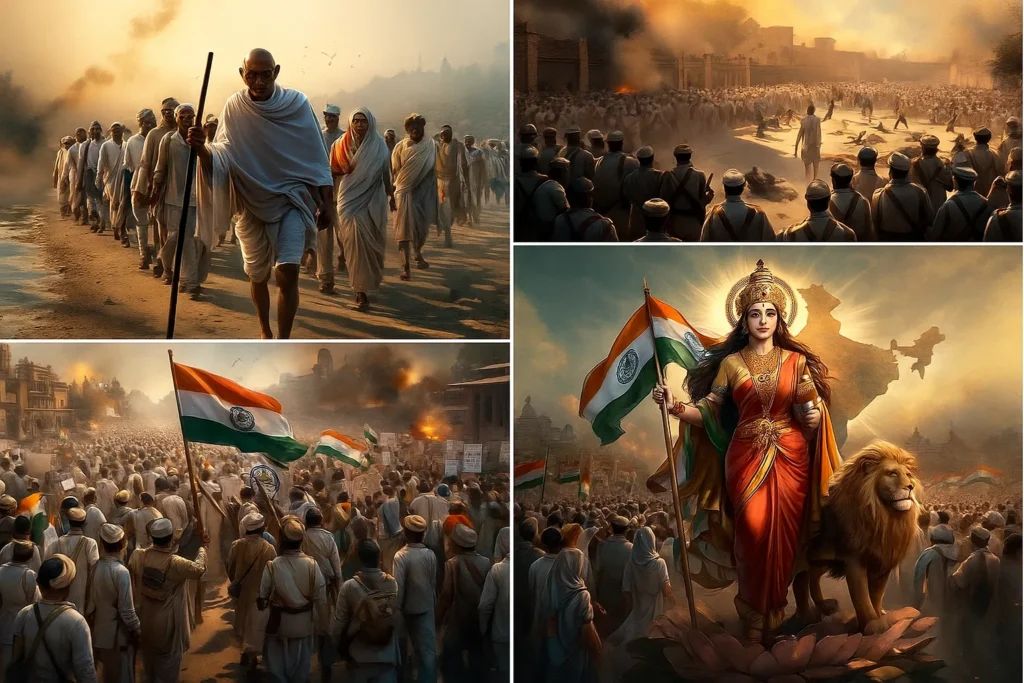
The First World War, Khilafat and Non-Cooperation
Situations After First World War
- First World War created big economic and political problems in India.
- British government increased defense spending and raised taxes.
- Doubled prices makes life very hard for people.
- Forced Recruitment: A process by which the colonial state forced people to join the army.
- Crop failure and influenza epidemic made the situation worse.
- People hoped things would improve after the war, but conditions became worse.
The Idea of Satyagraha
- Introduced by Mahatma Gandhi.
- He returned to India in January 1915 after fighting against racist laws in South Africa through Satyagraha.
- Satyagraha (Satya – Truth and Agraha – Holding firmly or insisting).
- Main Ideas of Satyagraha:
- Fight against injustice with truth and non-violence.
- No use of physical force or anger.
- Try to change the heart of the wrongdoer by showing truth and love.
- Peaceful, resistance (like protests, strikes, boycotts) is used instead of violence.
- Gandhi believed that truth and non-violence can unite people and bring real freedom.
- Example:
- Champaran (1917, Bihar): 1917: Farmers were forced to grow indigo on their land. They were paid very little and suffered losses. Gandhiji helped them to end this unfair system.
- Kheda (1917, Gujarat): Due to crop failure, farmers couldn’t pay tax. Gandhiji and Patel’s peaceful protest forced the government to reduce the tax relaxation.
- Ahmedabad (1918, Gujarat): Gandhiji helped the Ahmedabad mill workers who were demanding higher wages. As a result, they got a 35% increase in their pay.
The Rowlatt Act
- In 1919, The British passed the Rowlatt Act in spite of Indian member’s opposition.
- It gave the government power to:
- Arrest anyone without trial for up to two years.
- Stop political meetings and control the press.
- Mahatma Gandhi launched a nationwide Satyagraha against this by calling hartal (strike) on 6 April 1919.
- On 13 April 1919, the Jallianwala Bagh massacre took place under General Dyer. When violence spread across the country, Gandhiji decided to call off the movement.
The Jallianwala Bagh Massacre
On 13 April 1919, a large crowd gathered at Jallianwala Bagh in Amritsar. Some came to protest peacefully against the Rowlatt Act, while others had come to celebrate the Baisakhi fair. General Dyer blocked the exits and ordered his soldiers to fire on the unarmed people, killing and injuring hundreds. This cruel act shocked the nation and became a turning point in India’s Freedom struggle.
The Khilafat Movement
- After the First World War, Turkey (Ottoman Empire) was defeated. The British punished Turkey and removed the Caliph (Khalifa), the religious head of Muslims.
- Indian Muslims started the Khilafat Movement to protect the Caliph’s position and show unity among Muslims.
- A Khilafat Committee was formed in Bombay (March 1919). Leaders like Muhammad Ali and Shaukat Ali led the movement.
- Gandhiji supported it to bring Hindus and Muslims together in the fight against British rule.
- At the Calcutta Congress Session (September 1920), Gandhi convinced leaders to start a Non-Cooperation Movement to support both Khilafat and Swaraj.
Non-Cooperation Movement
- In his book Hind Swaraj (1909), Mahatma Gandhi said that “British rule continued only because Indians cooperated with it. If Indian refused to cooperate, British rule would collapse, and Swaraj (self-rule) would come within a year.
- He proposed that Indian should peacefully stop cooperating with the British.
- Give up British titles and honors.
- Boycott British schools, courts, offices, and foreign goods.
- Refuse to serve in the British army and police.
- If the government became violent, start full Civil Disobedience Movement.
- During 1920, Gandhi and Shaukat Ali travelled across India to gain public support.
- At the Nagpur Congress Session (December 1920), the party approved the Non-Cooperation Movement.
Differing Strands within the Movement
The Non-Cooperation Khilafat Movement began in January 1921. Different social groups joined the movement, each with their own hopes and aims. Everyone supported the call for Swaraj but it meant different things to different people.
The Movement of Towns
- The Non-Cooperation Movement started with the middle class in cities.
- Students, teachers, and lawyers leaving British Schools, colleges, and courts.
- Foreign cloth and goods were boycotted, and Khadi was promoted.
- The movement slowed down because:
- Khadi was costly, so poor people couldn’t afford it.
- No proper Indian institution (school, courts etc.) to replace British ones.
Picket: A type of peaceful protest where people stand outside a shop, factory, or office to stop others from entering or buying things.
Note: During the Non-Cooperation Movement, Indian boycotted the British elections. But in Madras, the Justice Party (Non-Brahmans) took part to get political power and speak for their community.
Rebellion in The Countryside
The Non-Cooperation Movement spread from cities to Villages. It inspired peasants and tribals to fight against British oppression, but many of them turned violent, unlike Gandhi’s idea of non-violence. Some examples are:
A. Peasant Movement in Awadh (Uttar Pradesh): The Peasant Movement in Awadh (UP) was led by Baba Ramchandra, a sanyasi who had worked in Fiji. They protested against landlords for high rents, unfair taxes, begar (forced work), and evictions. They demanded lower rent, an end to begar and boycott of cruel landlords. Jawaharlal Nehru helped form the Oudh Kisan Sabha in October 1920, which soon had over 300 branches. Later, some peasants became violent, attacking landlords and refusing to pay taxes, which Congress did not support.
B. Tribal Movement in Gudem Hills (Andhra Pradesh): The British closed forests, stopping tribals from grazing cattle or collecting wood and fruits. They were also forced to do begar. This caused anger and revolt. Alluri Sitaram Raju became the leader of the tribal rebellion. People believed he had magical powers and was an incarnation of God. He admired Mahatma Gandhi and supported khadi and no alcohol but believed India could be freed only through armed struggle. His followers attacked police stations and British offices. Raju was captured and executed in 1924, but he became a folk hero.
Swaraj in the Plantations
- Plantation workers in Assam also joined the Non-Cooperation Movement.
- Under the Inland Emigration Act (1859), they were not allowed to leave the tea gardens without permission.
- For them, Swaraj meant freedom to move freely and return to their village.
- Thousands left plantations and tried to go home, believing “Gandhi Raj”. But they were caught and beaten by police.
Towards Civil Disobedience
In February 1922, Mahatma Gandhi withdrew the Non-Cooperation Movement. Reason: The movement had turned violent in some place (Like Chauri Chaura) and Gandhiji felt people needed training in non-violence.
- After the withdrawal, Congress leaders were divided into two groups.
- C.R. Das and Motilal Nehru formed the Swaraj Party (1923). They wanted to enter the councils (British-created legislatures) and oppose British policies from inside.
- Jawaharlal Nehru and Subhas Chandra Bose wanted mass movements for full independence instead of council politics.
Simon Commission (1928)
The British government set up the Simon Commission to review and recommend reforms for India’s governance. But Indians opposed it because the commission did not have a single Indian member. They were all British. Indians protested with the slogan “Simon Go Back”. During one protest, Lala Lajpat Rai was injured by police and later died.
Demand for Purna Swaraj (Complete Independence)
- In 1929, Lord Irwin promised dominion status (Partial Independence) in future but gave no clear plan.
- Congress was not satisfied. At the Lahore Session of Congress (December 1929), under Jawaharlal Nehru, Congress declared the goal of Purna Swaraj (Complete Independence).
- 26 January 1930 was celebrated as Independence Day, with people taking a pledge to fight for freedom.
- But participation was limited, so Gandhi decided to launch a new mass movement that connected freedom with people’s daily lives. This became the Civil Disobedience Movement.
The Salt March and the Civil Disobedience Movement
- On 31 January 1930, Gandhi sent 11 demands to Viceroy Irwin (for workers, peasants, all classes). He wanted that if demands were not accepted by 11 March, Civil Disobedience would start.
- The Salt March (Dandi March): When Viceroy Irwin refused to negotiate. Gandhi began the Salt March on 12 March 1930 with 78 volunteers. It was 240 miles, from Sabarmati Ashram to Dandi, taking 24 days. On 6 April 1930, Gandhi broke the salt law by making salt from sea water. This started the Civil Disobedience Movement.
- Why Salt? Gandhi Choose salt because everyone needed it – rich and poor. The Salt tax showed the unfair and harsh nature of British rule.
- Peoples Response: People broke the salt law, boycotted foreign goods, and refused to pay taxes. They also picketed shops and violated forest laws.
- British Reaction: They arrested Congress leaders one by one. Arrest of Abdul Ghaffar Khan led to huge protests in Peshawar. Gandhi’s own arrest caused industrial workers (Sholapur) to attack symbols of British rule.
- Gandhi-Irwin Pact (1931): It is an agreement between Mahatma Gandhi and Viceroy Irwin. Gandhi agreed to pause the Civil Disobedience Movement and attend the Round Table Conference. The British agreed to release political prisoners.
- Round Table Conference (1931): It held in London. No agreement was reached. Gandhi returned to India disappointed and found:
- Nehru and Ghaffar Khan in Jail.
- Congress declared illegal.
- Protests banned.
- Gandhi Restarted the Civil Disobedience Movement, but by 1934 it slowly came to an end.
How Participants Saw the Movement
- Rich peasants supported the movement because they could not pay high land revenue during the Depression. They wanted reduction of revenue and felt upset when the movement ended without this.
- Poor peasants were tenants who could not pay rent to landlords. They wanted rent to be cancelled, but Congress did not fully support their demands.
- Businessmen supported the movement to get freedom from British trade restrictions. Later they withdrew because they feared strikes and growing socialist ideas.
- Industrial workers joined in small numbers to protest low wages and bad working conditions. Congress avoided taking up workers’ demands to not upset industrialists.
- Women joined in large numbers; they marched, made salt, picketed shops, and many were arrested. However, Congress gave them only symbolic roles, not leadership positions.
Limits of Civil Disobedience
Dalits and Muslims did not fully join the Civil Disobedience Movement for different reasons. Dalits wanted political safeguards like separate electorates, while Muslims feared Hindu domination due to rising communal tensions. This limited the unity of the national movement.
Dalits (Untouchables)
- Many Dalits were not moves by the idea of swaraj.
- Congress earlier ignored dalit issues to avoid upsetting conservative Hindus.
- Gandhi worked to end untouchability, called them Harijans, and organized temple entry satyagrahas.
- But many dalit leaders wanted reserved seats and a separate electorate for political power.
- Dr. B.R. Ambedkar formed the Depressed Classes Association (1930). At the Round Table Conference, he demanded separate electorates for dalits. British agreed but Gandhi opposed and went on fast unto death. He believed that separate electorates for dalits would slow down the process of their integration into society.
- Poona Pact (1932):
Muslims
- Some Muslims were unhappy with the Congress after the end of the Khilafat Movement.
- From the 1920s, Congress was seen close to Hindu Nationalist groups, causing mistrust.
- Communal riots increased and Hindu Muslim tension grew.
- Attempts to unite Congress and Muslim League failed. (All Parties Conference 1928).
- Many Muslims feared their identity and culture would be dominated by the Hindu majority.
- So, Muslim participation in Civil Disobedience was low.
The Sense of Collective Belonging
Nationalism is the feeling of belonging to one nation. It created when people develop a shared sense of unity through common struggles, cultural symbols, images like Bharat Mata, folk traditions, and history that builds pride in their collective identity.
Factors responsible for Nationalism in India
- National Symbols and Images: The idea of Bharat Mata and songs like Vande Mataram (Both by Bankim Chandra Chattopadhyay). Abanindranath Tagore painted Bharat Mata as a calm, divine and spiritual woman.
- Folk Tales and Traditions: Collection of folk songs, stories, and legends by nationalists like Rabindranath Tagore (Bengali) and Natesa Sastri (Tamil Songs – The Folklore of Southern India) helped revive Indian culture and pride. Folk traditions were seen as national culture that united people beyond region and language.
- National Flags and Symbols: During the Swadeshi Movement in Bengal, a tricolour flag (Red, green and yellow) was designed with eight lotuses for eight provinces and a crescent moon for Hindu-Muslim unity. In 1921, Gandhiji introduced another tricolour (Red, green and white) with a spinning wheel (charkha) in the center, symbolizing self-reliance and unity.
- Reinterpretation of History: Indian leaders and writers began rewriting history to remind people of India’s great ancient achievements in art, science and culture. This was done to build pride and confidence among Indians.
When the past that was praised focused only on Hindu culture, and the images and symbols used where mainly from Hindu traditions, people from other religions felt excluded and not part of that national identity.
Quit India Movement
The Quit India Movement was launched by Mahatma Gandhi on 8 August 1942 at the Bombay session of the Congress. It began after the failure of the Cripps Mission and the hardships caused by World War II, which created widespread dissatisfaction in India. Gandhiji demanded that the British must leave India immediately and gave his famous “Do or Die” speech. The movement quickly spread across the country. People of all groups organized hartals, strikes, protests with national slogans. Leader like Jayprakash Narayan, Aruna Asaf Ali, and Ram Manohar Lohia took part in it. Women like Matangiri Hazra, Kanaklata Barua, and Rama Devi also took part. Quit India became the final major struggle against British rule.
Conclusion
Nationalism in India or Indian nationalism united diverse groups through shared struggle. Yet unity was fragile, different visions, classes, and goals coexisted. Congress under Gandhi’s leadership gave direction and identity to India’s freedom movement.
Nationalism in India CBSE PYQ
Nationalism in India RBSE PYQ
Explore Our Quality Contents
All Class 10 Social Science Chapters
All Class 10 Science Chapters
Suggest Links
NCERT Official Text Books
Rajasthan Board Official Site
CBSE Official Site