
Forest and Wildlife Resources
Forest and Wildlife Resources – Chapter 2 Class 10 Geography (NCERT)
Forest and Wildlife Resources is Chapter 2 of Class 10 Geography (Contemporary India – II). This chapter helps students understand biodiversity, conservation, types of forests, and various community-led efforts to protect natural ecosystems. Below are comprehensive notes aligned with NCERT, RBSE and CBSE board exam patterns.
Biodiversity
The earth or the entire habitat that we live in has very large biodiversity. Biodiversity refers to variety of life forms on earth. Human depends on biodiversity for basic life needs such as:
- Re-creating the quality of air, we breathe
- Purifying the water, we drink
- Increase nutrition in soil for food production.
- Industrial raw material
Flora and Fauna in India
Flora refers to the plant life found in a particular region. Fauna refers to the animal life of a particular region. India is one of the world’s richest countries in terms of its large biological diversity (One of the 12 megadiversity of world).
Conservation of Forest and Wildlife
Conservation means preserving and protecting natural resources. Conservation is essential:
- Maintain Ecological balance and preserve biodiversity
- Support human life and maintain Water, air, and soil quality.
- Preserve genetic diversity of plants and animals for better growth and breeding.
- Sustain future generation and protect cultural values.
The Wildlife Protection Act (1972)
This act was implemented in 1972, with various provisions for protecting habitats. It aimed at safeguarding the country’s wild animals, birds and plants.
Main Provisions:
- Ban on hunting of endangered species.
- Legal protection of habitats.
- Regulation of wildlife trade.
Outcomes:
- Creation of national parks and wildlife sanctuaries
- Listing of protected species.
- Several animal specific protection projects launched for highly threatened animals such as Tiger, One-horned rhinoceros, Kashmir stag (Hangul), Crocodiles (3 types – Freshwater, saltwater and Gharial), Asiatic lion, Indian elephant, Black buck (Chinkara), Great Indian bustard (Godawan) and Snow Leopard.
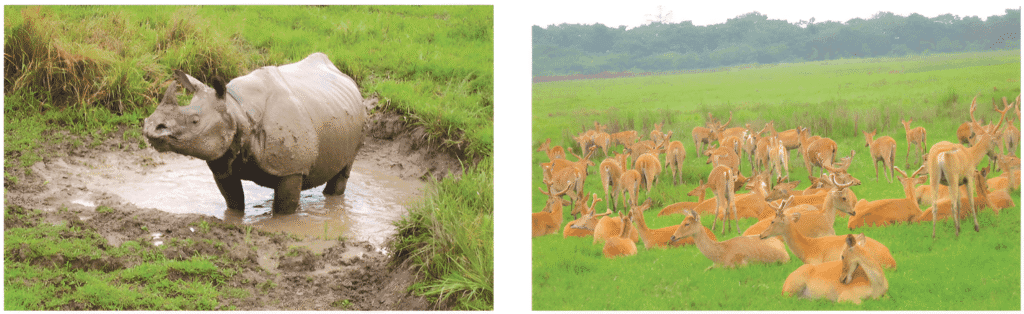
Later Modification and Extensions:
- Wildlife Act extended in 1980 and 1986 to include Butterflies, Beetles, Moths, Dragonflies.
- In 1991, plants were also added to protected list (total 6 Plants).
Project Tiger (1973)
Tiger is a key species in the faunal web. It plays a vital role in maintaining ecological balance in forests. It survival is essential to protect the entire forest ecosystem.
Major Threats to Tigers:
- Poaching or hunting for:
- Skin Trade
- Bones used in traditional medicines (especially in Asian countries).
- Shrinking habitats due to deforestation and human settlements.
- Increasing human population and conflicts with tigers.
- Illegal wildlife trade. (India and Nepal major targets, because of 2/3 population of tiger).
- Reduction in number of prey species.
Project Tiger launched to save the rapidly declining tiger population (Reduced to 1827 in 1973). The objectives are:
- Save the endangered tiger species.
- Preserve the larger ecosystem (biotypes) in which the tiger lives.
Major Tiger Reserves in India
| Name | State |
| Corbett National Park | Uttarakhand |
| Sundarbans National Park | West Bengal |
| Bandhavgarh National Park | MP |
| Sariska Wildlife Sanctuary | Rajasthan |
| Manas Tiger Reserve | Assam |
| Periyar Tiger Reserve | Kerala |
Types of Forest
Forests and wildlife resources are either owned or managed by the government through the Forest Department or other government departments. Forests are classified into following categories:
1. Reserved Forests
- Forests which have highest level of legal protection. High restriction on human activites.
- 50% of total forest land.
- Most valuable for conservation of forest and wildlife.
- States: Jammu and Kashmir, Andhra Pradesh, Uttarakhand, Kerala, Tamil Nadu, West Bengal, Maharashtra have large % of reserved forest.
2. Protected Forests
- Forest under a middle level of protection.
- 1/3 of total forest area.
- Limited activities allowed with regulation.
- These forest are protected from any further depletion.
- States: Bihar, Haryana, Punjab, Himachal Pradesh, Odisha, Rajasthan.
3. Unclassed ForestsWhich state has a high proportion of reserved forests?
- These areas are not officially classified as reserved or protected. It means they are neither reserved nor protected by law.
- These include wastelands, community owned forests, private forest land and forest not managed by the forest department.
- States: All North-estern states and parts of Gujrat (Often managed by local community).
Permanent Forests
- Reserved and protected forests are collectively known as permanent forests.
- These remain as forest permanently. They are used for long term conservation and planned use.
- These are maintained for:
- Timber production
- Forest produce
- Ecological protection
- Madhya Pradesh has the largest area under permanent forest (75% of its total forest area).
Community and Conservation
Forests are home to some tribal and local communities. These communities often have a deep understanding and respect for natural ecosystem. They believe that only conservation of resources and habitat will secure their own long term livelihood.
Community Led Conservation Examples
1. Sariska Tiger Reserve, Rajasthan
- Villagers opposed mining in the protected area.
- Used the Wildlife Protection Act to legally fight against habitat destruction.
2. Bhairodev Dakav Sonchuri (Alwar, Rajasthan)
- Five villages in the Alwar district of Rajasthan have declared 1,200 hectares of forest as a community conservation area. Name it “Bhairodev Dakav Sonchuri”.
- Created their own rules:
- No hunting allowed
- Protection from outside Invasion.
3. Chipko Movement (Himalayas)
- Chipko Movement began in 1973 in Uttarakhand.
- Villagers, especially women, hugged trees to prevent them from being cut.
- It was led by Sundarlal Bahuguna and Gaura Devi.
- Main Objectives:
- Stop deforestation
- Promote community afforestation using indigenous plant species.
- Preserve ecological balance.
4. Revival of Traditional and Eco-Friendly Farming
- Beej Bachao Andolan (Tehri): To save native seeds and promote traditional organic farming.
- Navdanya: To protect seed diversity, promote organic farming without use of synthetic chemical.
- Both movements have shown that diversified crop production with good income is possible through traditional and eco-friendly farming methods.
5. JFM (Joint Forest Management)
- JFM is a programme in India that involves local communities in the protection, management and restoration of degraded forests.
- Started in 1988 in Odisha.
- In JFM, Village committees work with the Forest Department.
- Communities protect forest land and in return, get:
- Non-timber forest products (Like fruits, honey, firewood)
- Share in timber after successful protection.
- JFM helps in conservation and gives economic benefits to local people.
- It is a good example of people’s participation in forest management.
6. Sacred Groves
- Sacred groves are patches of forests protected by local communities due to religious or cultural beliefs. These forests are left untouched and considered the home of gods and goddesses.
- Tribes like the Mundas and Santhals worship trees like mahua and kadamba.
- Tribes of Odisha and Bihar worship the tamarind and mango.
- In Indian culture, peepal and banyan trees are also considered sacred.
- Springs, hills, animals and even monkeys near temples are protected as holy.
- In Bishnoi villages of Rajasthan, animals like blackbuck, nilgai, and peacocks live safely among people.
The tree is a peculiar organism of unlimited kindness and benevolence and makes no demand for its sustenance and extends generously the products of its life activity. It affords protection to all beings, offering shade even to the axe men who destroy it.
Gautama Buddha (487 B.C.)
NCERT Textbook Questions – Chapter 2 Forest and Wildlife Resources
1. Multiple Choice Questions
- Which of the following conservation strategies do not directly involve community participation?
A. Joint Forest Management
B. Beej Bachao Andolan
C. Chipko Movement
D. Demarcation of Wildlife Sanctuaries
Answer: D. Demarcation of Wildlife Sanctuaries
2. Match the Following
| Column A | Column B |
|---|---|
| Reserved forests | Forests are regarded as most valuable for the conservation of resources. |
| Protected forests | Forest lands are protected from any further depletion. |
| Unclassed forests | Other forests and wastelands belonging to both government and private individuals and communities. |
Correct Matching:
- Reserved forests → Forests are regarded as most valuable…
- Protected forests → Forest lands are protected…
- Unclassed forests → Other forests and wastelands….
3. Short Answer Questions (30 Words)
(i) What is biodiversity? Why is biodiversity important for human lives?
Answer: Biodiversity refers to the variety of life forms on Earth, including plants, animals, and microorganisms. It is essential for ecological balance, food, medicine, climate regulation, and supporting life systems.
(ii) How have human activities affected the depletion of flora and fauna?
Answer: Deforestation, industrialization, mining, overgrazing, and poaching have led to habitat destruction and extinction of species. Pollution and urban expansion also contribute to biodiversity loss.
4. Long Answer Questions (120 Words)
(i) Describe how communities have conserved and protected forests and wildlife in India.
Answer: Several Indian communities have actively participated in protecting forests and wildlife.
- The Chipko Movement in Uttarakhand saw villagers hugging trees to prevent cutting.
- In Odisha, the Joint Forest Management (JFM) program involved communities in forest protection and regeneration.
- In Rajasthan, villagers declared the Bishnoi Sacred Groves as protected zones.
- In Alwar district, people created the Bhairo Dev Dakav Sanctuary, protecting wildlife from poachers.
- Many tribes and local groups have cultural practices and taboos that discourage deforestation and animal hunting.
These examples highlight the role of traditional knowledge and collective responsibility in conservation.
(ii) Write a note on good practices towards conserving forest and wildlife.
Answer: Good conservation practices include:
- Afforestation and reforestation to restore green cover.
- Banning poaching and illegal trade of animals.
- Establishing national parks, wildlife sanctuaries, and biosphere reserves.
- Promoting eco-tourism and awareness campaigns.
- Supporting Joint Forest Management and community-led conservation.
- Encouraging the use of alternative resources to reduce forest pressure.
- Strengthening laws like the Wildlife Protection Act (1972).
- Sustainable and inclusive conservation ensures ecological balance and long-term survival of forest and wildlife resources.
Forest and Wildlife Resources PYQs
Forest and Wildlife Resources RBSE PYQs
- What is Biodiversity?
- ‘Manas Tiger Reserve’ is situated in which state?
- Write one characteristic of reserved forests.
- Explain in brief the ‘Forest Conservation by Community’.
- Why is conservation of forest and wildlife necessary?
- When were plant first included to the list of protected species?
- Implement Chipko movement in your area.
Forest and Wildlife Resources CBSE PYQs
- Identify the movement related to forest conservation.
(a) Chipko Movement
(b) Narmada Bachao Andolan
(c) Swadeshi Movement
(d) Quit India Movement - What is Chipko Movement?
- Define Biodiversity.
- What are reserved forest?
- Name two movements which aimed at conserving forests.
- Describe any three steps taken by the Indian government to conserve forest and wildlife resources.
- Why is biodiversity important to human life? Give three reasons.
- How have communities contributed to conservation and protection of forests and wildlife in India? Explain with examples.
Forest and Wildlife Resources – Practice Questions
Multiple Choice Questions
- __ has the largest area under permanent forests, consituting 75 percent of its total forest area.
(a) Orissa
(b) Madhya Pradesh
(c) Chhattisgarh
(d) Assam - Reserved and Protected forests are also referred to as:
(a) Unclassed forest
(b) Permanent forest
(c) Open forest
(d) Mangrove forest - Which forest conservation method includes allowing villagers to protect forests in exchange for forest produce?
(a) Joint Forest Management
(b) Afforestation
(c) Biosphere reserves
(d) Wildlife sanctuaries - Which of the following is a flora species?
(a) Lion
(b) Sal tree
(c) Peacock
(d) Tiger - The Chipko Movement was mainly against:
(a) Hunting of animals
(b) Deforestation
(c) Mining
(d) Wildlife poaching - Which state has a high percentage of its forests as unclassed forests?
(a) Madhya Pradesh
(b) Kerala
(c) Gujarat
(d) Rajasthan - Which of the following were included in the protected species list under the Wildlife Act of 1980 and 1986?
(a) Only mammals
(b) Butterflies, moths, beetles, and one dragonfly
(c) Reptiles and amphibians only
(d) Plants and shrubs - When were plants first added to the list of protected species under the Wildlife Act?
(a) 1980
(b) 1986
(c) 1991
(d) 2000 - How many plant species were initially added to the protected list in 1991?
(a) Four
(b) Six
(c) Eight
(d) Ten - Which of the following is a traditional movement for preserving seeds and promoting ecological farming?
(a) Chipko Movement
(b) Navdanya
(c) JFM Program
(d) Project Green
Fill Ups
- The Indian Wildlife Protection Act was implemented in the year __________.
- __________ forests are regarded as the most valuable for conservation.
- Project Tiger was launched in the year __________.
- The __________ community in Rajasthan protects blackbuck and other wildlife.
- Sacred groves are patches of forests preserved for __________ reasons.
- In Joint Forest Management (JFM), forest protection is done by __________.
- The Chipko Movement originated in the __________ region.
- In the Alwar district of Rajasthan, villagers declared 1,200 hectors of forest as _________.
- In ______, the state of ______ passed the first resolution for joint forest management.
- The tribals of Odisha and Bihar worship the _______ and _______ trees during weddings.
- The Beej Bachao Andolan in _____ promoted traditional seed saving and organic farming.
Very Short Answer Types Questions
- Name a few trees that are considered scared in India?
- Corbett National Park and Sundarban National Park is Located in Which state?
- When was Project Tiger Launched?
- What percent of Madhya Pradesh’s total forest area is under permanent forest?
- Define Biodiversity.
- Name two national parks in India.
- What is the full form of JFM.
- Which act provides legal protection to wildlife in India?
- Which two countries provide habitat to two-thirds of the world’s tiger population?
- Name any two insect groups that have been added to the protected species list under the Wildlife Act.
- Which state has a high proportion of reserved forests?
- Which famous tiger reserve is located in Kerala?
- Which traditional tree is worshipped by the Mundas and Santhals of Chota Nagpur?
- What do local communities receive in return for JFM participation?
- What are scared grooves?
Explore Our Quality Contents
All Class 10 Social Science Chapters
All Class 10 Science Chapters
Suggest Links
NCERT Official Text Books
Rajasthan Board Official Site
CBSE Official Site