
Globalisation and The Indian Economy
Globalisation and The Indian Economy – Chapter 4 Class 10 Economics (NCERT)
Globalisation and the Indian Economy explains how countries are becoming interconnected through trade, investment, and technology. It highlights the role of MNCs in spreading production across nations and integrating markets. The chapter also shows how liberalisation and WTO have promoted globalisation. Students learn both its benefits (greater choice, new opportunities) and drawbacks (job insecurity, pressure on small producers). Finally, it stresses the need for fair globalisation so that all sections of society benefit equally. Below are complete notes of this chapter aligned with NCERT, RBSE, and CBSE board exam patterns.
Introduction – Globalisation and the Indian Economy
Today, we see a wide variety of goods in the market – mobiles, TVs, cars, clothes, and food products from many world-class companies. This was not the case 20 years ago when choices were very limited. The arrival of new brands and products has quickly changed Indian markets. In this chapter, we will learn what causes these changes, what globalisation means, and how it affects people’s lives.
Production Across Countries
Before the middle of the twentieth century, most production used to happen within each country. Only a few things crossed the borders such as raw materials, food items, and finished goods. For example, during colonial times India exported raw materials like cotton and food items, while finished goods such as clothes and machinery were imported from Britain. Trade was the main way through which countries were connected. Later, the rise of Multinational Corporations (MNCs) changed this system by spreading production across different countries.
MNCs – Multinational Corporations
Multinational Corporations are companies that own or control production in more than one country. Reason for expansion: MNCs expand to different countries mainly to reduce the cost of production. They look for cheap labour and easily available resources. They also set up units closer to big markets so that selling becomes easier. All these steps help them to earn higher profits.
Example: A multinational company designs its machines in the US, makes parts in China, assembles them in Mexico and Eastern Europe, and sells them worldwide. Its customer care is handled from India. This shows how MNCs not only sell globally but also produce globally. Each country is chosen for its advantage – China for cheap manufacturing, Mexico and Eastern Europe for closeness to markets, and India for skilled engineers and English-speaking youth. By dividing work across countries, the company reduce costs and earns more profit.
Interlinking Production Across Countries
MNCs set up production in countries where cheap skilled and unskilled labour is available, raw materials and other resources are easily available, markets are nearby, and government policies are favorable.
- Foreign Investment: Money spent on land, building, and machines is called investment. When MNCs invest in another country, it is called foreign investment. They do this to earn more profit.
Expansion of Production by MNCs
- Buying Local Companies: The most common method of expansion is simply buying local companies. The wealth and power of MNCs are often bigger than the budgets of developing countries, so they can easily do this. Example: Cargill Foods from the USA bought Parakh Foods in India. This gave Cargill Foods control over Parakh’s brand, network, and oil refineries, and made Cargill Foods the biggest edible oil producer in India.
- Joint Production with Local Companies: Sometimes, MNCs set up production jointly with local companies. Benefits for local companies:
- Financial support for expansion.
- Access to modern technology.
- Using Small Producers as Suppliers: Big MNCs do not always produce in their own factories. They often give orders to small producers in different countries to make goods like clothes, shoes, and sports items. These goods are then sold under the MNC’s brand name (like Nike or Adidas). The MNC controls everything—price, quality, delivery, and even working conditions.
By joining with local firms, buying them or using them as suppliers, MNCs connect production across countries. This creates global interlinking of production, connecting economies across the world.
Foreign Trade and Integration of Markets
Foreign trade means the exchange of goods and services between different countries. It includes imports (buying from other countries) and exports (selling to other countries). Function of foreing trade:
- Expands choice for consumers.
- Allows producers to sell beyond domestic markets.
- Creates competition between local and foreign producers.
- Equalizes prices of similar goods in different countries due to competition.
Foreign trade connects the markets of different countries. By allowing goods to move across borders, it increases consumer choice, creates competition among producers of different nations, and makes prices of similar goods come closer. In this way, foreign trade performs the function of integration of markets.
What is Globalisation?
Globalisation is the process of rapid integration or interconnection between countries. It is flow of production and investment among various foreign countries.
Role of MNCs in Globalisation: MNCs play a major role in globalisation. They spread production to many countries. Foreign trade has increased because of them. Goods, services, technology, and money now move across borders. This connects markets worldwide. People also move for jobs and education, though less than trade and investment.
Factors That Have Enabled Globalisation
Technology
- Rapid progress in technology has made globalisation possible.
- Faster and cheaper transport helps goods move quickly across long distances.
- Telecommunication devices like telegraph, telephones (including mobiles), fax, satellite communication, and Internet allow instant sharing of information and low-cost global contact.
Liberalisation of Foreign Trade and Investment Policy
- Globalisation also became possible because many governments removed trade barriers.
- Trade barriers are government rules that restrict the free flow of goods and services between countries. They are mainly of two types:
- Tariff Barriers: Taxes on imports.
- Non-tariff Barriers: Quotas, subsidies, and licensing.
- Governments can use trade barriers to increase or decrease foreign trade and to decide what kinds of goods and how much of each, should come into the country.
- After Independence, India put trade barriers to protect new industries. Only essential goods like machines, oil, and fertilizers could be imported.
- From 1991, the India government reduced trade barriers. The aim was to make Indian producers compete with global producers and improve their quality.
- Liberalisation: Removal of government restrictions on trade and investment. It opened the Indian economy to the world. Now, trade, investment, and economic activities can grow more easily. The aim was to let Indian producers compete with global producers and improve their quality.
World Trade Organization
The liberalisation of trade and investment in India was supported by powerful international organizations. These organizations believe that barriers to trade and investment are harmful, and all countries should allow free trade.
WTO (World Trade Organization)
- WTO is an international organization whose main aim is to liberalize international trade. It is established in 1995 at initiative of developed countries. Including India there is 160 countries are its members.
- Role of WTO: WTO sets rules regarding international trade. It ensures that these rules are obeyed by all member countries. It promotes free trade by reducing trade barrier.
- According to WTO all barriers to foreign trade and investment are harmful. According to them, world trade should be free and without restrictions.
- Criticism: Developed countries keep their own trade barriers to protect their own producers but ask developing countries to remove such rules. For examples, the US gives subsidies to its farmers, so they can sell crops at very low prices in other countries. This hurts farmers in developing countries.
Impact of Globalisation in India
- On Consumers: Globalisation has given people more choice of goods like mobiles, cars, clothes, and food. Competition has improved quality. Prices become lower and living standards rise, especially in cities.
- On Producers: Globalisation has affected producers in both good and bad ways. Indian companies improved by using new technology, better quality, and higher standards. A few companies became MNCs like Tata Motors, Infosys, Asian Paints and Ranbaxy. Partnerships with foreign firms gave Indian companies modern technology and access to world markets. But at the same time, small producers suffered. They faced strong competition from big MNCs. Many small units in toys, dairy, tyres, vegetable oils, batteries closed down.
- On Workers: Big growth in IT and service sectors. Creating jobs in call centers, data entry, accounting, publishing and engineering. But many workers face tough working conditions. Most jobs are in the unorganized sector with low pay and no jobs security. Even in the organized sector, jobs are now less secure, and benefits have reduced.
Struggle for Fair Globalisation
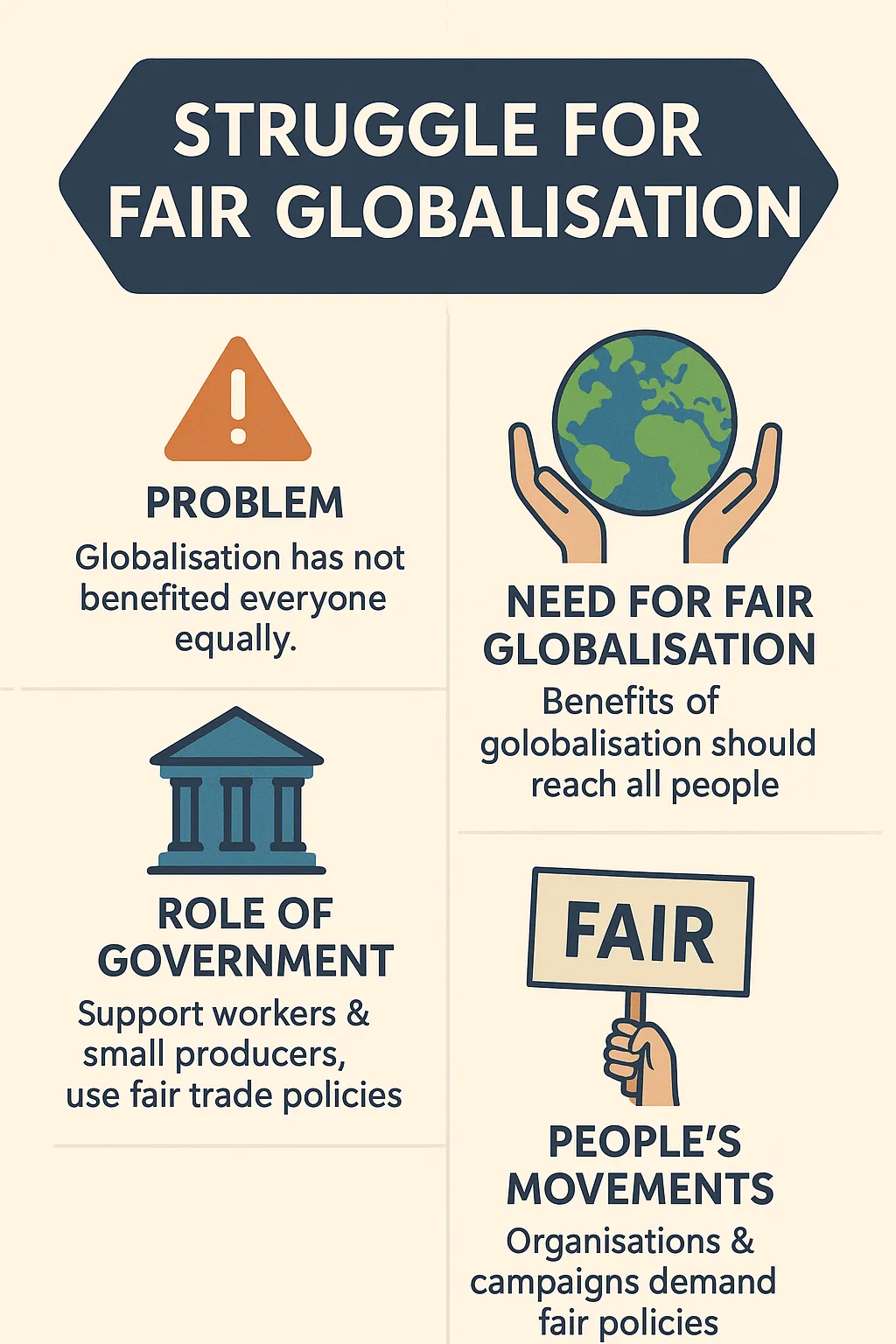
- Problem: Globalisation has not benefited everyone equally. Rich and skilled people gain more, while small producers and workers suffer.
- Need for Fair Globalisation: Fair globalisation should create equal opportunities for all. It should ensure that benefits of globalisation should be shared more equally.
- Role of Government: The government should protect the interests of all, not just the rich. It must ensure that labour laws are followed so workers get their rights. Small producers should be supported until they become strong enough to compete. If required, trade and investment barriers should be used. The government should also negotiate at the WTO for fairer rules and work together with other developing countries to oppose domination by developed nations.
- Role of People: People’s organizations and campaigns can also influence decisions at the WTO. This shows ordinary people can play a big role in the fight for fair globalisation.
Globalisation and The Indian Economy CBSE PYQ
Globalisation and The Indian Economy RBSE PYQ
Explore Our Quality Contents
All Class 10 Social Science Chapters
All Class 10 Science Chapters
Suggest Links
NCERT Official Text Books
Rajasthan Board Official Site
CBSE Official Site